This week, we watched a film called Most Likely to Succeed (2015). The film challenges the notion of whether traditional schools are adequately preparing students for the real world. It follows students at High Tech High in the United States, a school that focuses on project-based and student-centered approaches to learning rather than traditional teaching methods such as writing papers, taking tests and learning through a lecture-based approach.
What Was Your Reaction to the Film?
This film made me think about my role as a future educator and as a former high school student. I agreed with the film’s emphasis on helping students discover their interests and using those interests to motivate learning. I also believe students should develop skills such as collaboration, critical thinking and creativity. However, I think it is equally important that students learn the curriculum and core subjects such as English, Math, Science, Social Studies and Art. Creativity can be fostered by giving students choice in how they demonstrate their learning and when appropriate, allowing them some autonomy in what they learn.
As a former high school student, I related to the girl who said, “I would rather learn how to ace the test.” I understood her perspective because she was referring to learning how to study and acquire the knowledge needed to get into college, where she would have more autonomy in choosing what she wants to learn and pursue as a career.
So What? Why Does This Matter?
What I find important is helping students succeed within the current education system while also preparing them for life beyond school such as fostering creativity, critical thinking and social skills. I am concerned with finding a middle ground between having a student-centered classroom and a teacher led classroom.
How Do I Achieve This as an Educator?
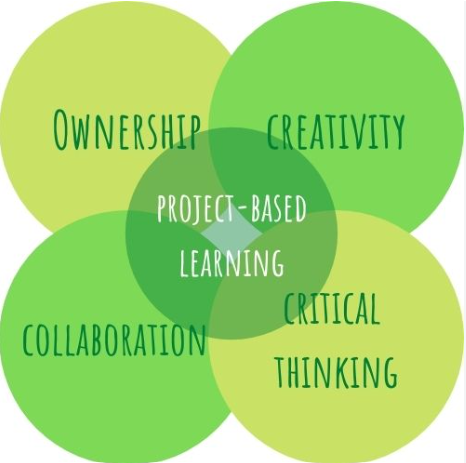
Image from: https://atutor.ca/pros-and-cons-of-project-based-learning/
- Project-Based Learning: Students develop knowledge and skills while working to solve a problem, answer a complex question, or investigate a real-world issue that is outline in the curriculum. Rather than demonstrating their learning through tests, students can showcase their understanding in a variety of ways, such as presentations, dioramas, videos, podcasts, posters, debates, research projects, performances, or digital portfolios. These alternative assessments allow students to apply their learning creatively while developing important skills such as communication, collaboration, critical thinking and problem-solving while learning the curriculum.
- Social Studies Curriculum: I learned very quickly that the Social Studies curriculum is very broad and I only recently learned why. The BC Social Studies curriculum allows for flexible teaching and learning because it has “fewer and broader required topics allows more time for teachers to engage in hands-on learning and inquiry activities rather than having to focus on covering a long list of required content.” Instead of simply memorizing dates and historical facts, students focus on exploring topics that interest them, while answering open-ended questions, engaging in debates and discussions about historical and contemporary issues. Students will learn how to critically think and come up with their own solutions to problems. This approach encourages deeper thinking and helps students make meaningful connections to their learning.
- The Everyday Use and Math and English: In our daily lives, we face numerical and literacy-related challenges. Math is important because it allows us to take complex problems and break them down into simpler steps. For example, when creating a budget, you can sort your income, expenses and extra spending money. English is important for understanding, learning and communicating. Therefore, it is important for educators to teach the Math and English curriculum. It is important for educators to make this learning more engaging by using manipulatives in math and helping students apply what they learn to real-world situations when teaching core subjects.