Free Inquiry Post #6
Over the last five weeks, I explored how outdoor mathematics education can be implemented across different grade levels while connecting to the BC Curriculum. For Kindergarten to Grade 3, I researched outdoor math activities and online resources that support hands-on, place-based learning. For Grades 4 to 7, I examined broader themes in outdoor education, including the use of technology and different ways students can demonstrate their understanding. For Grades 8 and 9, I investigated how outdoor mathematics supports inclusive education, the benefits and challenges associated with this approach and assessment strategies teachers can use to evaluate student learning in outdoor environments.
Throughout this inquiry, I gained a deeper understanding of how outdoor mathematics can increase engagement, provide meaningful real-world learning experiences and support diverse learners. While there are challenges related to planning and safety, the potential benefits for student learning and well-being make outdoor mathematics a valuable educational approach across all grade levels.
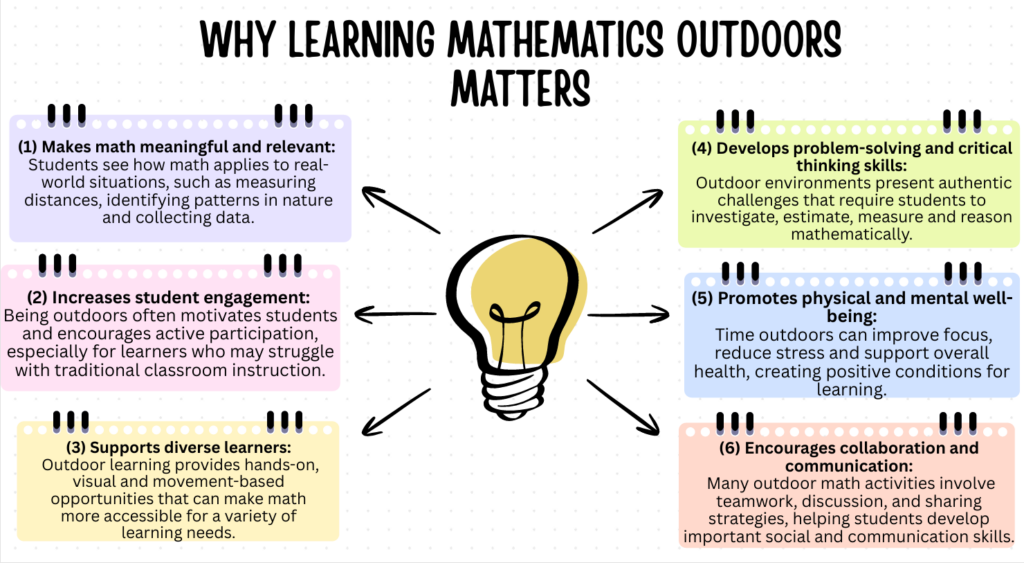
Created by me on Canva
The Why of Outdoor Learning
(1) Outdoor math learning makes math meaningful and relevent.
When students collect data outdoors, use natural objects for measurement, or conduct surveys while learning statistics, they are connecting math to real-life experiences. When students understand why they are learning math and how it applies to the world around them, they are more likely to stay motivated and retain the information they learn.
(2) Outdoor math learning increases student engagement:
Outdoor math learning increases student engagement by providing students with opportunities to move, explore and interact with their environment. Learning in an outdoor setting can make math more enjoyable and meaningful, which helps students stay focused and actively participate in their learning.
(3) Outdoor learning supports diverse learners.
Outdoor learning supports diverse learners by giving students the opportunity to approach math in different ways rather than relying solely on paper-and-pencil tasks. Outdoor learning supports diverse learners because it provides multiple ways for students to engage with math and demonstrate their understanding.
(4) Outdoor learning develops problem-solving and critical thinking skills.
(5) Outdoor learning promotes physical and mental well-being.
It encourages movement and provides students with regular opportunities to spend time in nature. Being outdoors can help reduce stress, improve focus and create a positive learning environment where students feel more relaxed and ready to learn. I chose to do my inquiry project on outdoor mathematics education because students spend a large portion of their school day learning Math and English. I wanted to explore ways to incorporate more outdoor activities into mathematics and discover resources that can help students spend more time learning outside.
(6) Outdoor learning encourages collaboration and communication.
Students work together to solve open-ended tasks, collect data and share their learning and findings. Through these shared experiences, students learn to listen to others, communicate their ideas clearly and deepen their understanding through discussion and teamwork.
Leave a Reply
You must be logged in to post a comment.