Free-Inquiry Post #4
I remember sitting in my Grade 9 math class and thinking, Why am I learning this? Why is it important? When will I ever use this after high school? Outdoor learning can help answer these questions by showing students how mathematics connects to real-life situations. I want to explore how outdoor math games can be used to teach Grade 8–9 mathematical concepts in ways that are engaging, hands-on and meaningful. By connecting math games to curriculum concepts, students can develop a better understanding of what they are learning and why it is relevant to their lives, all while having fun and learning outdoors!
Probability
Cornhole is a great outdoor activity for teaching students experimnetal probability. This can “be calculated by performing actual experiments and gathering or recording the necessary information.“
This would be calculated by Number of Outcomes / Number of Trials. Students take turns tossing beanbags toward a cornhole board and record the outcome of each throw.
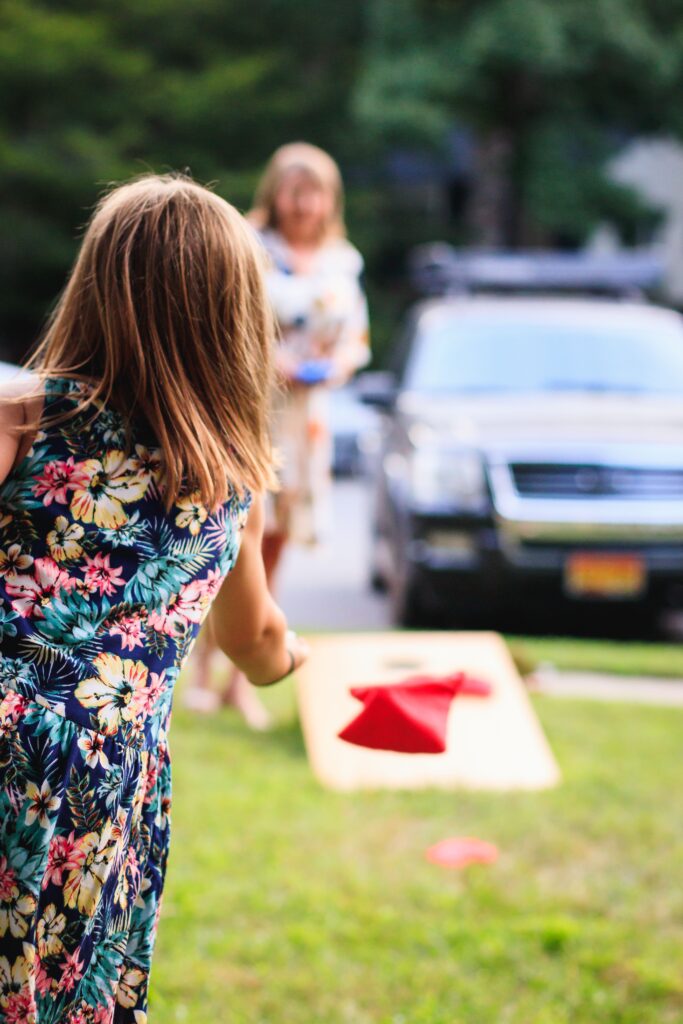
Photo taken by Michael Morse from Pexels.
Measurement:
Students could create their own shapes using masking tape, chalk, or rope. Students divide into small groups and create a shape. They then calculate the area and perimeter of their shape using measuring tapes or rulers. Groups rotate around the playground and calculate the area and perimeter of another group’s shape. They can check their answers against the original group’s calculations.
To turn this into a game students can:
- Create a shape with a perimeter of a certain amount of meters.
- Create two different shapes with the same perimeter but different areas.
- Work as a team to create a shape with a given perimeter and explain how changing its dimensions affects its area on a piece of paper.
I got this idea from: Outdoor Area and Perimeter Shape Activity on EducateOutside.com
Algebra
The video below features outdoor math games presented by teacher Holly Millican, who explains how to use them in the classroom. One of the games she describes is called Bean Bag Algebra, which aligns with the Grade 8 algebra learning standards in the BC Curriculum. Although, the teacher can make problems more complex to suit learning standards for different grade levels.
Bean Bag Algebra is a game where students toss bean bags to practice solving algebra questions.
For example,
- Students toss a bean bag onto a number.
- They use that number to replace x in an equation.
- They solve the equation.
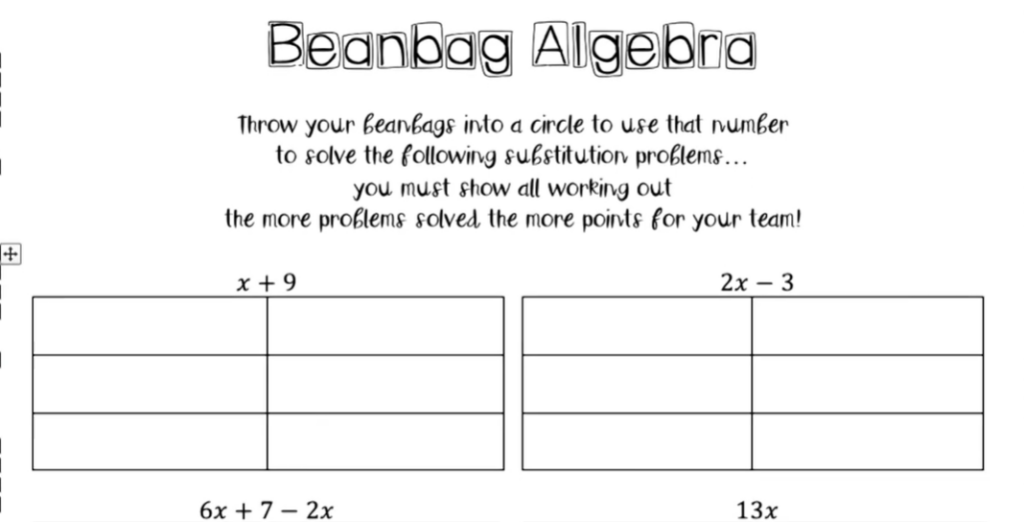
These are examples of math questions she has students answer. She usually has students working in groups of 2–4, taking turns running up to the pre-drawn chalk circles and throwing a bean bag at a circle. This activity focuses on content knowledge, collaboration and teamwork skills!
These are just a few examples of math games that can be done outdoors! It is important to keep in mind that outdoor math games and learning is essential because:
- It is active learning though play.
- Helps students develop problem-solving and teamwork skills.
- Helps students get more physical activity throughout the day and supports those who struggle with attention and focus.
Leave a Reply
You must be logged in to post a comment.