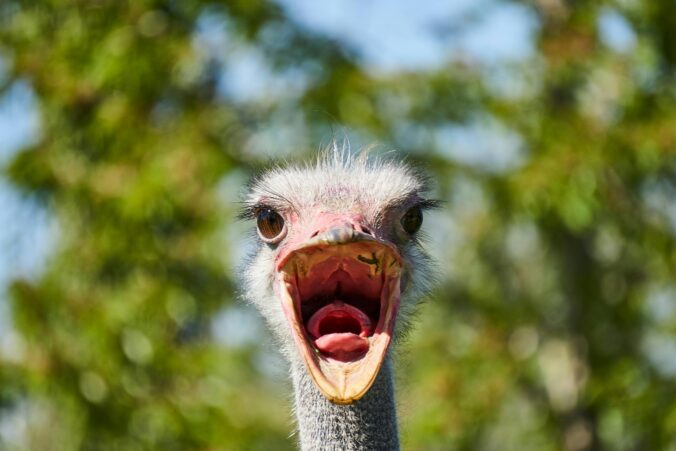
The book I read to the Kindergarten class was If You Laugh, I’m Starting This Book Over by Chris Harris. This is a funny book that challenges listeners not to laugh. With humorous illustrations, goofy phrases and silly names throughout the text, students find it impossible to resist laughing!
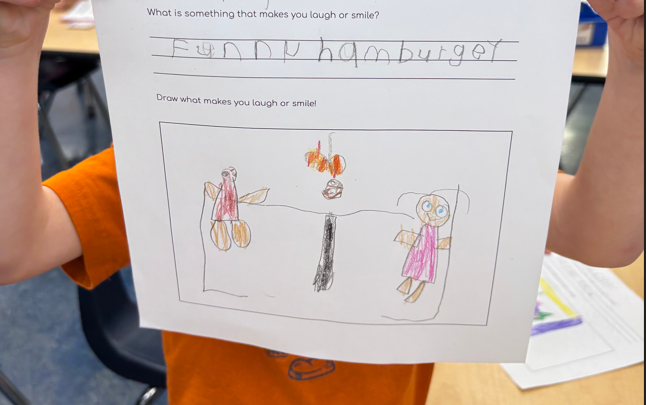
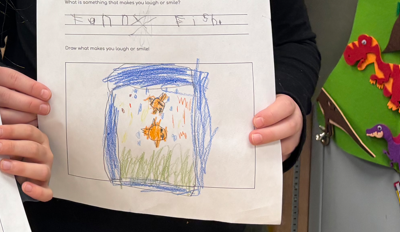
After the book was read, students participated in an activity where they wrote about something that makes them laugh or smile or could write something from the book that was funny. They then drew and coloured a picture based on what they wrote. With the support of two educational assistants (EAs) and the teachers’ help, the activity went very well. Students were able to write a full phrase or sentence about something they thought was funny or a part of the book they found amusing, with guided support. If a student could verbally express a phrase, the EA would write it on a small whiteboard and the student would copy it onto their paper.
If a Kindergarten class did not have this level of support in the classroom, I would have conducted the writing activity as a whole-class exercise. Students could have verbally shared what they found funny and we would focus on a drawing activity instead, taking into account that Kindergarten students are still developing their writing skills.

Image retrieved from: https://dcmp.org/media/19266-if-you-laugh-i-m-starting-this-book-over
Here are the prompts:
EVALUATE
Background Knowledge:
I read this book to a Kindergarten class where students were already beginning to write words and knew most alphabet letters. With this in mind, I planned an activity that would challenge them while still being fun and engaging. By combining writing and drawing, I aimed to support their emerging literacy skills while giving them room for creativity and self-expression.
Funds of Knowledge:
This book does not tie into the culture or socio-economic status of students. It focuses on the students’ sense of humor and whether they will find the text funny. It was also a way to test if students would find it amusing, as I was unsure due to their age. The humor largely depends on how the book is read, including tone of voice and facial expressions, which the students found hilarious when I read the book to them.
Potential Stumbling Blocks:
Given the students are in Kindergarten, the potential stumbling blocks for this activity may include concepts or vocabulary that are new to some learners. Students knew how to write the letters of the alphabet, but they struggled when writing words. This is when students learn about decoding. From Sometimes Reading is Hard, explains structured teaching approaches to teaching decoding that are important. For example, programs such as UFLI and Heggerty teach phonology skills and how to decode words (Bright, 2021). Students focus on sounds and letters of language by using techniques such as rhyming, blending words, breaking words into sounds, clapping syllables and learning “heart” words such as the, to, of, are, was, you and more (Bright, 2021).
Instructional Opportunities:
After the reading, students demonstrated emerging independence by writing their own names at the top of the page. For the writing portion, the EAs supported students by writing their spoken sentences on whiteboards for the students to copy. This activity provided instructional opportunities to observe letter formation, word writing and spacing, while also allowing students to express their creativity. For example, drawings differed such as a “silly hamburger” or a vibrant sunset that made a student smile.
EXPLAIN
Brainstorm Unfamiliar Words:
| Words to Teach | Short, Simple, Straightforward Definitions | Words to Explain | Short, Simple, Straightforward Definitions |
| One million dollars | “An enormous amount of money, much more than we can count.” | Rules | “Things that we are supposed to follow. When a student is asked to follow a rule, they do it.” |
| Serious | “Serious means your body and face are calm.” “You can be serious when you are focusing.” “You are serious when something is not funny.” “When you are telling someone something important or when someone is telling something important to you.” | Chicken McStinkbreath Eyeball | “This is a silly made-up name that is supposed to make you giggle because it is so ridiculous and random.” |
| Secret | “Something you know, but will not tell anyone else.” | Captain Fuzzyhair Snaozzdripple | “This is a silly made-up name that is supposed to make you giggle because it is so ridiculous and random.” “The captain must have hair that feels soft, fluffy and looks a little messy to be called Captain Fuzzyhair!” |
| Disobey | “Disobeying means not choosing to listen or follow the rules.” |
Think Alouds:
If I had more time in the lesson, I could have taught all students these words listed to help them understand the vocabulary more clearly. Especially for Kindergarten students, they may know what rules are, but do they actually know the true meaning? Teaching the definitions of words and helping students create their own definitions helps them comprehend the story more deeply.
Stopping or Pausing Points:
In this book, there are not many stopping points because students are waiting patiently to hear the “big thing” the book keeps mentioning. Near the end, the book explains that asking the listener not to laugh is ridiculous. A stopping point could be asking, “Why is it ridiculous to be asked not to laugh?” The end of the book also says that a person’s laugh is the most wonderful thing. The teacher could ask, “Why is laughing important? Why is laughing beautiful?” Students could then brainstorm how joyful, happy and laughter-filled moments are beautiful. Near the very end, the book says, “If you ever stop laughing, then you will have to give me one million dollars!” The teacher could pose a question and ask students why the author wrote this. Stopping points could be directed for students to make meaning of the text and have more of an understanding of their social-emotional skills. As it explains in Read Alouds For All Learners it is important to engage students in discussion and ask questions about the text to help them articulate concepts and have a developed understanding of the text (Ness, 2024).
ENGAGE and EXTEND
Social Emotional Learning Engagement:
Social emotional learning during this activity looked like: students talk about what makes them happy or laugh and express ideas through drawings or shared sentences. The end of the book says that the “big thing” is to never stop laughing because a person’s laugh is the most wonderful and beautiful thing. Through this reading, students learn to recognize and value their own emotions, particularly joy and happiness. This connects to Kindergarten English Language Arts (ELA) curricular competency “Use personal experience and knowledge to connect to stories,” (BC Ministry of Education, n.d.). Students learn through narrative texts about human nature, emotions and experiences (BC Ministry of Education, n.d.) . When these young learners write about their emotions and experiences helps them understand their feelings better and learn more about their well-being.
Cross-Curricular Extensions:
This book and the activity links with the big idea “Language and story can be a source of creativity and joy,” (BC Ministry of Education, n.d.). This activity would connect to core competency “Creative Thinking” because the BC Ministry of Education highlights that Creative Thinking involves the generation of ideas that are meaningful and connect to the text. For example, a student wrote about a “silly hamburger” with eyeballs and a surprised expression. This is creative because it is original and fits the theme of the book. This would be an example of a creative product that has value because it is a form of self-expression (BC Ministry of Education, n.d.). The message of this book and the class activity connects to the eighth First People’s Principles of Learning “Learning requires exploration of one’s identity,” because students were able to reflect on the story’s main message, connecting it to their own experiences and emotions.
Extensions to Support Reading and Writing:
As an extension of this activity, students could share their ideas and drawings with a partner to build their storytelling and oral language skills.
Resources:
https://www.bookwormforkids.com/2022/11/todays-read-if-you-laugh-im-starting.html
Bright, R. M. (2021). Sometimes Reading is Hard: Using Decoding, Vocabulary, and Comprehension Strategies to Inspire Fluent, Passionate, Lifelong Readers. Pembroke Publishers.
British Columbia Ministry of Education. (n.d.). English Language Arts: Kindergarten – Core Competencies, Big Ideas, and Curricular Content. Curriculum, Government of British Columbia. https://curriculum.gov.bc.ca/curriculum/english-language-arts/K/core
Ness, M. (2024). Read Alouds for All Learners: A Comprehensive Plan for Every Subject, Every Day. Solution Tree Press.