Novel Study:
On February 10th, 2026 by Lindsay Andersen – EDCI 402 Reading Instructional Principles and Strategies. Good Reads Assignment
The following PDF is my grade four novel study, co-created with Eva Sommerfeld
Novel Study – Charlie and The Chocolate Factory
Three Picture Books:
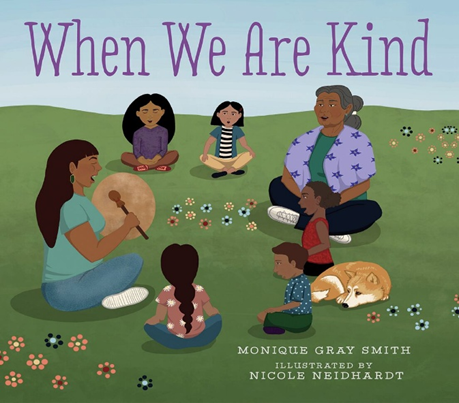
Retrieved from: https://www.cbc.ca/books/when-we-are-kind-1.5735632
Book Title: When We Are Kind
Author: Monique Gray Smith
- Indigenous
- Canadian
- Queer
Book Illustrator: Nicole Neidhardt
- Indigenous
- Canadian roots (received her Bachelor of Fine Arts Degree from University of Victoria).
- Queer
Book Type: Fictional children’s picture book.
Grade Level(s): Kindergarten to grade two.
Topics: This is a book about social emotional learning focusing on themes about being kind, empathetic and is about community.
Subjects: This book is about simple acts of kindness. This book celebrates simple acts of kindness towards us, our neighbors and the environment. The book highlights emotions that come with being kind such as joy, happiness, comfort and love when we initiate or receive kindness. This book highlights Indigenous culture such as being interconnected with nature by giving and receiving kindness to the land.
Curricular Content/Competencies: Looking at the kindergarten English curricular competencies, this book would fall under ‘comprehend’ and ‘connect.’ More specifically, “Use sources of information and prior knowledge to make meaning,” (BC Curriculum, n.d.). Students will do an activity after reading the book where they will write something they have done to show kindness or an act of kindness someone has done for them. This is an example of them sharing personal stories and experiences connected with the reading. This book would also fall under ‘create’ and ‘communicate’ curricular competency. This lines up with “Exchange ideas and perspectives to build shared understanding,” because students will be actively listening to the story, (BC Curriculum, n.d.). They will also be taking turns offering ideas related to the topic of being kind. Students can share how they show kindness to their friends, family, themselves and the natural environment in whole-class discussion. This lesson can be cross curricular with a connection to kindergarten science. There is an environmental conservation theme in the book, students can draw connections to plants and animals and what they need to survive in the natural environment.
Book Summary: When We Are Kind, written by Monique Gray Smith, illustrated by Nicole Neidhardt, is about what everyday kindness looks like, such as what it looks like to receive kindness from those in your inner circle and community. It is a story about celebrating simple acts of everyday kindness. Examples in the text include “I feel joy when my family and I are kind,” and “I am kind when I only take from the Earth what I need.” There are themes of empathy and caring for the environment. This book reflects Indigenous culture using illustrations of Indigenous families and children. The book also discusses caring for the environment. Indigenous culture has a reciprocal and spiritual relationship with nature.
Book Activity: This activity is fit for kindergarten to grade two. The teacher hands out a heart-shaped paper to each student and they will write something they have done to show kindness or an act of kindness someone has done for them. Once they have finished, they fold their heart in half and place it in a mason jar. Once all the students have written their own paper, the teacher will anonymously draw out a heart and read what it says in front of the whole class. This activity would take some time because young students may need inspiration about what to write about and spelling words correctly. In kindergarten, if students are struggling with writing words or have not yet learned all the letters in the alphabet, this activity can be done as a whole class. The teacher would have students raise their hands and share ideas, then the teacher would write on a paper heart as ideas were said. Then, the teacher would have each student come up to the front of the classroom and glue one heart to a blank piece of paper, where it would be displayed.
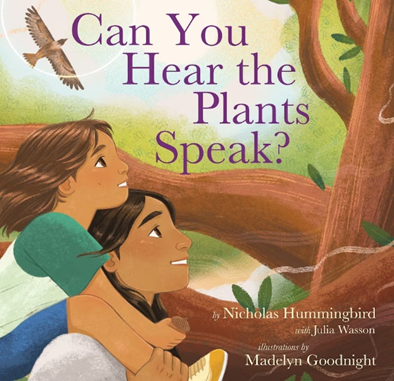
Book retrieved from: https://www.indigo.ca/en-ca/can-you-hear-the-plants-speak/9780063221284.html
Book Title: Can You Hear the Plants Speak?
Author(s): Nicholas Hummingbird and Julia Wasson
- Indigenous
- BIPOC
Book Illustrator: Madelyn Goodnight
- BIPOC
Book Type: Non-fiction environmental education picture book.
Grade Level(s): Kindergarten to grade three.
Topics: This is a book about environmental education and protecting the environment. More specifically, it focuses on the topic of Indigenous traditional and ecological knowledge about the belief that plants and nature are alive. Indigenous people’s have kinship and a reciprocal relationship with nature that is valuable. Overall, this book covers topics such as family, conservation of the environment and understanding nature, including humans affects on nature.
Subjects: This reading emphasizes Indigenous cultural concepts of nature. The book provides young learners with knowledge about how Indigenous connections to land are affected by government systems, including pipelines, forestry, hunting and as the book highlights, construction. In traditional ecological knowledge, there is spirit in everything, especially the land, which is alive just like humans. Therefore, we need to conserve and protect nature. Our relationship with nature is reciprocal. When we give to the land by not taking too much and taking care of it, the land says “thank you” by providing us with plants that grow, clean rivers and increasing animal species. This book includes information about biology and plant cycles. Therefore, this book focuses on subjects such as Indigenous knowledge and science.
Curricular Content/Competencies: This reading would connect to kindergarten science. It would fall under content learning standards “basic needs of plants and animals,” (BC Curriculum, n.d.). Students will learn the basic needs of plants when they plant their seed in soil that grows with sunlight and water. This connects to the part in the story of the plant that is growing in the city of big buildings, traffic and pollution. The book explains a bit about plant lifecycles making a connection to the subject of biology. It would fall under curricular competency ‘questioning’ and ‘predicting.’ Once students plant their seed, they will look for patterns in plant growth, questioning these patterns and making connections such as “how do these patterns explain plant growth in your local environment?” (BC Curriculum, n.d.). This book is cross curricular because it aligns with curricular competency ‘create’ and ‘communicate,’ for kindergarten English. Under this curricular competency it explains that students “Create stories and other texts to deepen awareness of self, family, and community,” (BC Curriculum, n.d.). This book teaches students that narrative text can teach us about ourselves, human nature and motivation (motivation to protect the environment).
Book Summary: The book is about a little boy who shares his stories about how there is spirit in nature. He spends his summer days with his great-grandparents exploring the rocks, plants and creeks where he lives. He listens to plants as they speak and explores his connection to the spirit of the natural world. He realizes that not everyone listens when the plants speak, which is why people tear up the land to build houses, shopping malls and other buildings, driven by capitalization. We listen to the land, but when we commit these acts, the land is silenced. The boy grew, but his great-grandparents passed away. He still carries the knowledge that they gave him, which is that he should listen to nature. He listened and learned, growing new plants with care, giving them to his family as a gift. He started to give back to nature and when plants flourish, it is their way of saying “thank you.”
Book Activity:
In kindergarten science, students learn content such as the basic needs of plants learning about plants habitats, food, water and shelter. Students can learn about all these factors that affect plant cycles while planting their own seeds in soil watching them grow. Students can discuss observations and draw conclusions about plant cycles.
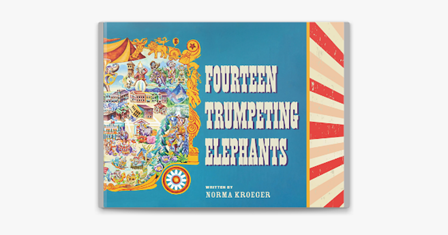
Retrieved from: https://books.apple.com/us/book/fourteen-trumpeting-elephants/id1488825302
Book Title: Fourteen Trumpeting Elephants
Author: Norma Kroeger
- Canadian local author.
Illustrator(s): Local artists near Cranbrook, British Columbia and students from Gordon Terrace Elementary School.
Book Type: Historical fiction children’s picture book.
Grade Level(s): Grade two to grade six.
Topics: This book shares different fictional stories of what Charlie Ed was doing during the time the searchers were trying to find him. The main topics of this reading are imagination, adventure, mystery and exploration of the natural environment.
Subjects: This book was inspired by the true story of elephants that escaped from the Sells Floto Circus in Cranbrook, British Columbia, in 1926. Due to this book being based on a real historical event, the book connects closely to the subject of history. The story also shares descriptions of different places that Charlie Ed travels to, such as swimming in the Moyie River. In addition, a man in the story describes traveling around the world and explains that the elephant is an Indian elephant from Asia. He also mentions seeing many beautiful elephants while exploring Thailand. These details connect the book to the subject of geography, which is taught in social studies.
Curricular Content/Competencies: This reading could be tied to grade six social studies. Could be a transition into historical events that occurred in the 1920s to the 1930s. This book, considering its timeline, could connect to content learning standards “Global poverty and inequality issues, including class structure and gender,” (BC Curriculum, n.d.). Some global events that occurred around this timeline was the beginning of the Holocaust in the 1930s, the Great Depression in the 1930s and under the topic of Chinese immigration stated on the BC Curriculum website students could learn about the Chinese Immigration Act in 1923, banning Chinese immigration. These events in history would fall under historical acts of racism and inequality. These topics could fall under curricular competency: “Differentiate between short- and long-term causes and intended and unintended consequences, of events, decisions, or developments,” (BC Curriculum, n.d.). Students can reflect on how these historical events have shaped our world. They could also reflect on their own actions and the consequences in their own lives. This can also be cross curricular, connecting to Grade six English curricular competency ‘create’ and ‘communicate’ where students can take what they have learned about events in history and show what they learned through meaningful and informational texts that can be shared with the class.
Book Summary: This is a story about a boy named Cody and his friends, Dustin and Julian who listen to Cody’s grandpa tell stories. Cody’s grandpa was telling stories passed down from his Uncle Will who was 14 years old that summer when Sells Floto Circus was in Cranbrook in 1926. One of the stories Cody’s grandpa told was about that one hot summer day in 1926 when the circus had arrived in Cranbrook, BC. Animals that were part of the circus were lions, dogs, horses, but most importantly, the elephants. The way it was heard was that a dog was barking at a rabbit that went under the elephant car. This startled the elephants and caused a “fight” or “flight” response, which flight is what the elephants choose. Almost all the elephants were found except for one, Charlie Ed. During the time Ktunaxa Elders and other searchers were trying to find Charlie Ed he was eating huckleberries from a big field, ate apples from an apple tree, protected a family from a big bear, helped crown the winner of the Cranbrook Gyro Club Auto Contest and more! Well, these were stories that people in the community shared of what they thought Charlie Ed was doing while he was being searched for.
Book Activity: With primary students, they could draw a picture and write their own version of what they think Charlie Ed was doing and where he could have been. This gives students to think creatively and be creative with their drawings. With a grade six class, this could tie into doing a research project about a historical event that occurred between the 1920’s to the 1930’s that would tie into the subject of social studies. Students could conduct research and be the experts on a global historical event that they would present as either a presentation, video, poster or other forms of representation. Students can share this information with the whole class.
Resources:
British Columbia Ministry of Education. (n.d.). Curriculum: Building Student Success. https://curriculum.gov.bc.ca/
Gould, R. K. (2023). Bridging Cultural Concepts of Nature: Indigenous People and Protected Spaces of Nature Bridging Cultural Concepts of Nature. Society & Natural Resources, 36(10), 1298–1300. https://doi.org/10.1080/08941920.2023.2183535